2026 Predictions
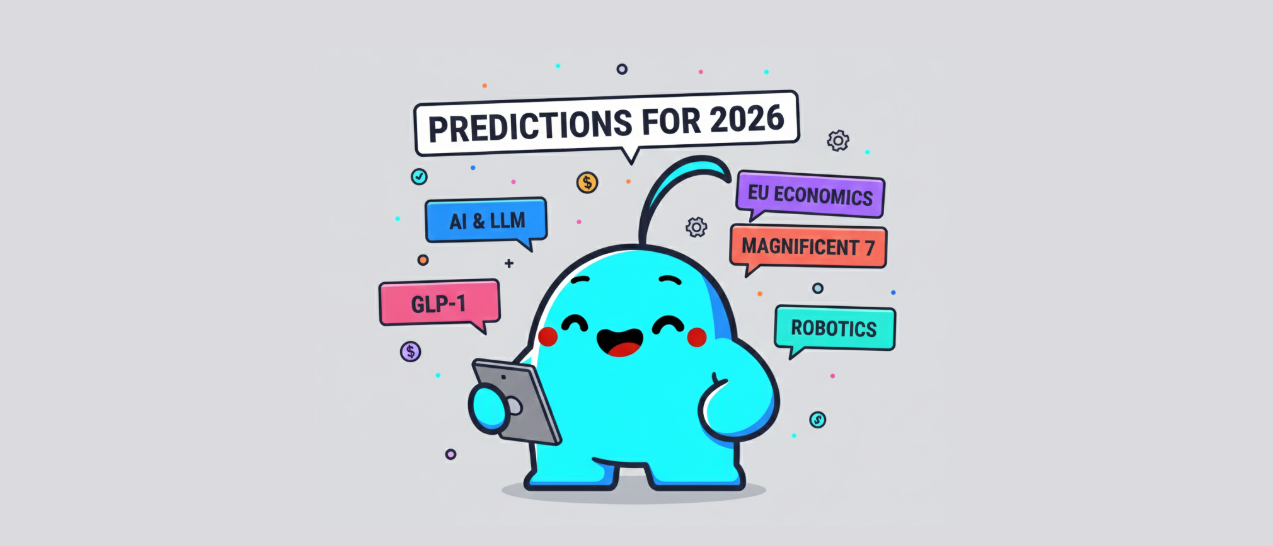
We collected predictions and put them on a bingo sheet. Time to see if you agree on our predictions and we will check every quarter whether we are closer to a bingo or not.
Some predictions are quite far-fetched just to start a discussion. Let’s look at all of them shall we?
Predictions
1. AI hype dies and turns into measurable business outcomes
Current AI “adoption” has been quite a bit all over the place but few outstanding project scopes we have seen where there are exact business outcomes. This also supports our other predictions here that AI will just be a part of the tech stack. Or LLMs to be more precise.
Axios frames 2026 to be the year of “show me the money”. S&P Global reports mixed outcomes as well.
2. AI bubble bursts (AI shareholder value drops by over 40%, Magnificent 7)
First signs are already visible in some interviews by business leaders and researchers where they are saying that the end of the scale up period is upon us. A lot of value has been attributed to AI development and as it might not continue in the similar fashion we will be seeing a downturn and exit of people to diversify their portfolios.
Guardian argues AI’s economics and unprofitability could trigger macro spillovers. Morningstar/Marketwatch discusses relative winners among the Magnificent Seven - rotation rather than collapse.
3. Quantum is the next AI (hype?)
It has been raising its head for a while and was a hot topic before LLM’s “appeared” and took out all the air in the tech discussions. Gartner-hype-cycle-based analysis bases that its back near peak of inflated expectations and 2026 prematurely being called the “year of quantum”
4. Moving to EU-based cloud platforms (growing faster of US counterparts)
Companies are hesitant and risk averse based on how US providers have acted. Also recent outages have raised concerns of their own on how robust their setup is. Hence turning to EU-based cloud providers and security being a huge factor here.
EU sovereignty concerns (GDPR, NIS2, DORA and US influence) boosts interests towards EU providers. However, lock-in remains strong with AWS and Azure controlling 60-80% share in the UK.
5. LLM pivot / hype dies down - one tech among others
Remember how LLMs came to market and were the solution to end all solutions? That ain’t the case and a lot of the investments haven’t provided the ROI that was hyped about. It is turning out to be a tool among others. You can greatly increase your productivity if you leverage them to their fullest potential.
Bain regards the real savings of applying AI thoughtfully and not regard it as the solution to everything.
6. Death of AI developer → AI is a tool in the workflow of every developer
As mentioned above the LLM tools we have been provided are going to be business as usual for developers. Specialized AI developers can be a title or similar to scope out the responsibilities of a person but not something people pay a premium for.
Reuters/METR findings that AI tools can slow experienced devs in familiar codebases. Reuters also reports AI having mixed results when it is part of the workflow.
7. Amazon being the winner of Magnificent 7 companies in terms of shareholder value generation
They haven’t built their own LLms or invested that heavily into buying chips. They have their own AI chip but where they are big is in robotics. USA has 1.4 million robots/robotic machines working in and over 1 million of those are owned and operated by Amazon. Could they even be said to be the Ford of AI revolution?
The Motley Fool has picked them as the top performer of 2026.
8. Year of the Linux computer consumer adoption
Steam bringing their gaming “console” that is based on Linux and Microsoft messing up with Windows to consumers dislike. This year might finally be the first breakthrough of Linux computer adoption for consumers. Everything is browser-based anyway besides games.
9. Rust’s enterprise adoption
Rust has been gaining traction steadily but could this year be the breakthrough for enterprise adoption? The New Stack survey supports the claim but raises concerns with tooling.
10. OpenAI bankruptcy
Having declared code red already late last year due to Google’s Gemini jump in performance in their newly released model and all the promised investments into datacenters could finally catch on. Needing to raise trillions in debt and new investments without being able to keep the promised growth can cause the house of cards to fall. Will it disappear? Doubtful since Microsoft will most likely absorb them in this case. From their official statement you can read between the lines readable: “OpenAI remains Microsoft’s frontier model partner and Microsoft continues to have exclusive IP rights and Azure API exclusivity until Artificial General Intelligence (AGI).”
11. Cloud cost control raises its head → Cloud provider revenue growth slows down
Companies are being cost-aware due to the economic situation and aiming to keep their cloud costs in control. Can expedite moving to other providers that are EU-based as well since they seem to be cheaper at the moment.
Reuters noted EU Data Act as a pressure point for cloud providers to offer cost saving options.
12. Data engineer roles focus turns largely into data pipeline optimization
The role of data engineering is disappearing and it is becoming part of the scope for roles already existing. For example for developers or devops people handling the data pipeline optimization and data scientists working together instead of having a dedicated role of a data engineer. However this most likely won’t hold true for larger organizations.
“Data engineering is becoming software engineering”
13. GLP-1 drugs will be the value driver, “replacing” AI
AI is becoming the norm and quite large-scale adoption has happened so investors’ eyes are turning to the next big thing. GLP-1 drugs bringing the solution to obesity problems in countries and greatly lessening the costs of healthcare will make countries look at offering them to their population. A healthier population has so many upsides to countries.
Barron: Strong momentum with competition, pill versions and growth
14. General consensus LLM ain’t the way for AGI
The scale-up phase of LLMs is done and consensus amongst researchers seems to be that it isn’t the way for AGI. It’s back to the research mode for the next breakthrough.
AAAI survey results indicate that a large share of researchers are skeptical that scaling current approaches will yield AGI.
15. Defence industry is the growth driver of EU’s economy
The massive investments into defence by EU and Nato countries will be the growth driver of the economy. They will kickstart it in and it will spread to other industries quite fast.
European Commission analysis estimates GDP uplift.
16. New 1 billion € startup in Finland
We have multiple potential companies that could reach with the next investment round or IPO the unicorn status. A few examples are: AlphaSense, Swappie, Enfuce and Canatu.
17. Finland’s gaming industry rebounds with new AI-native studios
We’ve been known for great gaming studios and the heavy hitters investing in new studios. AI has evened out the entry costs even more for new studios and faster proof of concepting.
18. Russian attack war on Ukraine ends
Fingers crossed sanctions and everything has worked and this will come to an end this year.
19. A breakthrough in fusion energy (more energy created and used)
It has been talked about for years and some promising technological leaps have been made. Could this year finally be the year it provides more energy and is viable for the first reactor building project to start?
20. Robotics being the efficiency creator of the year
LLM’s are very good at helping robots work better and you might have already seen a lot of videos about them. Including releases of new models. The amount of efficiency companies like Amazon will get can be terrifying and what it does the labor market isn’t looking great.
21. China takes lead in AI models over US
China provided the new cheaper models last year which shocked the western AI companies. Could they flood the market and hurt the US economy with their models by offering them for much cheaper but 80% of the performance?
DeepSeek’s training method being a “breakthrough” for scaling efficiency.
22. Substantial outage increases due to AI assisted coding
AI coding is on a knife’s edge. There are the supporters and skeptics. Will it cause an increase in outages and potential more massive outages due to AI code?
23. Tech debt from AI adoption becomes a dominant software engineering theme
Some companies have already experienced this. Reckless use of AI for coding has increased complexity to the limits of human capacity to understand and increased costs instead of lowering them. Does the tech debt created in this way be the software engineering theme of the year?
InfoQ reports on AI-generated code creating new technical debt vectors (model churn, code bloat, fragmentation, etc.)
24. Death of junior software consultant
Has the junior software consultant died? Can you have faster induction of new developers to companies and companies only wanting to pay for seniors to bring order and technical excellence to the teams?
25. AI content filters to content platforms
TikTok users are already complaining about AI content. People want to engage with real people so will this force platforms to have filters or start truly favoring actual content creators again?
Filters or labels are becoming normal.
Bingo sheet