The vocabulary of software development is shifting faster than most organisations can track. Developers are using terms like “agentic AI”, “MCP”, and “AI-assisted development” in planning meetings, in pull request comments, and in conversations about why things are taking longer than expected.
This guide explains what these terms actually mean — not how they appear in vendor marketing, but how they affect the way software is built, maintained, and paid for.
AI-Assisted Development
AI-assisted development refers to software development where a large language model (LLM) — such as GitHub Copilot, Cursor, or Claude — helps write, review, or explain code.
The most common form is code completion: a developer types a function name or a comment, and the AI suggests the rest. More advanced uses include generating entire modules from a plain-language description, writing tests, refactoring legacy code, and reviewing pull requests.
The key distinction: in AI-assisted development, a human developer is still in the loop. The AI suggests; the developer decides. This is different from agentic AI, where the decision loop is largely automated.
AI-assisted development is already standard practice. Studies from 2025 found that over 70% of professional developers at software companies use some form of AI coding tool daily. The productivity gains are real — and so are the new risks.
Agentic AI Development
Agentic AI development takes the next step. An AI agent does not just suggest code — it plans, executes, and iterates autonomously across multiple steps.
Give an agent a task: “Write a REST API for user authentication, add tests, and open a pull request.” An agentic system breaks this into sub-tasks, writes the code, runs the tests, fixes failures, and submits the PR — often without a human reviewing each step.
Tools like Claude Code, Devin, and OpenAI’s Operator represent this category. They are not autocomplete — they are autonomous actors that use tools, browse documentation, run terminal commands, and make sequential decisions.
For organisations, agentic development changes the cost model of software delivery. Tasks that previously required a developer’s full attention for hours can be delegated. But this introduces a new question: who is responsible for the decisions an agent makes? And how do you audit what it did?
Agentic development is not a replacement for skilled developers. It is a force multiplier — one that amplifies both the strengths and the weaknesses of the development environment it operates in.
Model Context Protocol (MCP)
MCP, or Model Context Protocol, is an open standard developed by Anthropic and released in late 2024. It defines how AI models connect to external tools, data sources, and systems.
Before MCP, every AI integration was custom-built. If you wanted an AI model to query your database, read your codebase, or call your internal API, you had to write a bespoke connector. Every tool vendor did this differently.
MCP standardises the interface. It is comparable to how HTTP standardised communication between web browsers and servers — a common protocol that any tool can implement once and any AI model can use.
In practice, MCP lets an AI model:
- Read from databases, file systems, and APIs
- Write to documents, repositories, and services
- Execute actions in connected systems — running tests, creating tickets, sending notifications
For a business leader, the significance of MCP is this: it dramatically lowers the cost of integrating AI into existing workflows. Once a system exposes an MCP interface, any MCP-compatible AI model can use it without custom development work.
For a developer, MCP means the AI tools they use can now have persistent, structured access to the actual systems they work with — not just a chat window, but a connected workspace.
MCP adoption grew rapidly through 2025. By early 2026, most major development tool vendors — including JetBrains, Microsoft, and HashiCorp — had released MCP servers for their products.
Technical Debt
Technical debt is not new terminology. But its meaning is changing under AI-assisted development — and worth revisiting.
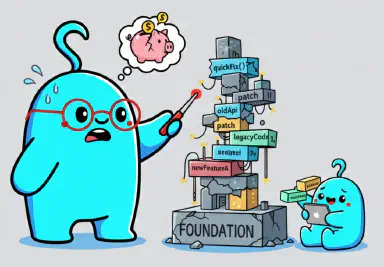
Technical debt is the accumulated cost of shortcuts. When a team ships code quickly but skips proper testing, documentation, or architectural decisions, they take on debt. That debt is paid later, with interest, when the shortcuts make future changes slower and more fragile.
In AI-assisted development, technical debt forms differently and accumulates faster.
AI tools optimise for immediate output. When a developer asks an AI to solve a problem, the model produces code that works for that specific case — but may not account for how it fits into the broader codebase. The same problem solved three different ways in three different parts of the system is hard to maintain. Nobody owns those solutions. Nobody even knows they are duplicates until something breaks.
We covered this in detail in our article on AI technical debt. The short version: AI lowers the cost of adding code and raises the cost of understanding it. This is the new face of technical debt.
For organisations, the implication is concrete: AI-assisted development teams need stronger code review practices, not weaker ones. The speed gained from AI is lost if every shortcut the model takes turns into a bug six months later.
How These Terms Connect
These concepts are not independent. They form a system — and understanding how they interact is more useful than knowing each definition in isolation.
AI-assisted development is the foundation. Most development teams are already here.
Agentic development is the next layer. Agents use AI assistance autonomously, across longer workflows. The speed increases further; so does the complexity of oversight.
MCP is the connective tissue. It defines how agents and AI tools access the systems, data, and tools they need to do useful work. Without a standard like MCP, agentic development is limited to what an AI can accomplish in isolation — which is considerably less.
Technical debt is the shadow cost. As AI writes more code faster, the debt accumulates differently — more duplication, less coherence, less visible to traditional analysis tools. Managing this debt requires intentional practices: code review, architectural ownership, and metrics designed for AI-generated code.
Together, these terms describe the new normal of software delivery. Organisations that understand them will make better decisions about tooling, process, and investment. Those that do not will be surprised by the consequences.
What This Means for Your Organisation
If your team is using AI tools in development — or evaluating whether to — these concepts are not abstract. They shape how fast you can move, how much you spend on maintenance, and how resilient your systems are.
The organisations that benefit most from AI-assisted development are not those that adopt every available tool. They are those that build deliberate practices around it: clear guidelines for AI use, a strong review culture, and metrics that make the health of the codebase visible.
AI acts as a multiplier — for good and for bad. Investing in the practices that make it a positive multiplier is the work.
How extreme programming practices apply to AI-assisted teams is something we explored in Extreme Programming and AI — worth reading alongside this one.
If you want to explore what responsible AI-assisted development looks like in practice, our services page outlines how Bytecraft helps organisations build that foundation.