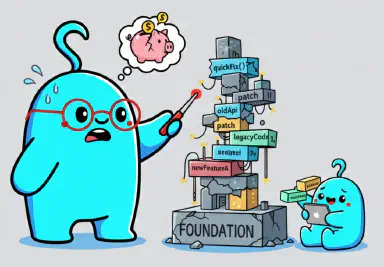
AI Is a Multiplier of Your Current State
When an organization adopts AI-assisted development tools, the common expectation is that productivity will rise. Code gets written faster, developers accomplish more, projects move faster. This is true, but only partially.
AI is not a solution to broken processes. It is a multiplier of the current state. If your organization’s processes work, AI accelerates them. If they do not, AI accelerates the problems.
Feature Factory Mode
One of our clients was in a situation where code and features were being produced rapidly. AI-assisted development delivered what it promised: developers were shipping software at an unprecedented pace. On the surface, everything looked good.
Then bugs started appearing. Pull requests piled up in review. Things were waiting for comments. Developers’ contexts shifted constantly, cognitive load grew.
The problem was not the AI tools. The problem was that the rest of the organization could not keep up. Review and testing processes had been sized for a different production rate. When the volume of code doubled, reviews and testing should have doubled too, but they did not.
Time Must Shift
When code production speed increases, review and testing become especially critical. Time must shift from other phases of development toward these. If it does not, things pile up. And things that pile up go stale.
Test-driven development (TDD) is one of the most effective ways to manage this challenge. When tests are written before code, AI-assisted development stays disciplined: test cases define the boundaries within which generative tools produce code. TDD is not just a technical practice — it is a structural guarantee that speed does not erode quality.
This is not a technical problem. It is an organizational one. AI tools do not solve the fact that not enough time is allocated to review. They do not solve the fact that testing is under-resourced. They do not solve the fact that nobody owns the whole.
AI exposes these problems faster. It accelerates the process to the point where bottlenecks become visible.
Discipline in Process
The biggest risk in AI-assisted development is not the quality of code produced by language models. It is the volume of code without a human-led design process. Complexity grows when developers “dump” code forward.
This is where software craftsmanship becomes critical. Software craftsmanship is not just technical skill — it is a professional attitude: code is written with care, tested thoroughly, and architectural decisions are made deliberately. Extreme Programming (XP) offers concrete practices for this: pair programming, continuous integration, small releases, and above all, test-driven development.
Discipline toward process and quality becomes extremely important. This does not mean heavier bureaucracy. It means clear principles about what happens before code is written, and what happens after.
If your organization does not have a culture where code is reviewed properly, AI will only make the situation worse. If testing is not prioritized, AI will produce more untested code. If architectural decisions are not made deliberately, AI will produce more architecturally scattered code.
Faster Quality or Faster Problems
AI is a multiplier. It scales whatever is already happening in your organization. If your structure works, you get quality faster. If it does not, you get problems faster.
Before you roll out AI tools widely, it is worth asking: are our processes ready for this? Does code review work? Is test-driven development part of how we work? Does someone own the whole?
If the answer is no, do not expect AI to fix these things. Expect it to make them visible.