AI Technical Debt Is Different
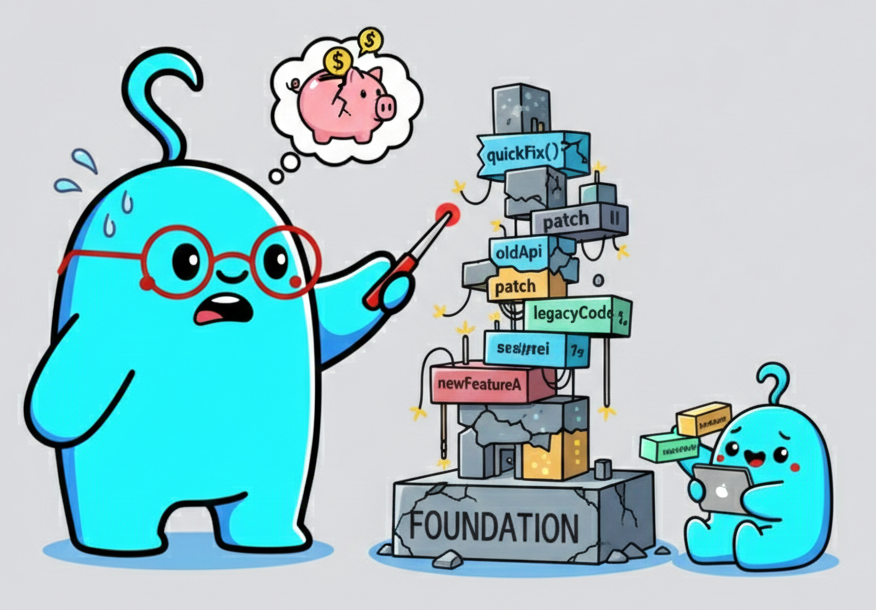
Technical debt is a familiar concept. Code is written quickly, quality suffers, and later a higher price is paid for changes. AI-assisted development does not remove technical debt — it changes its nature.
AI lowers the cost of adding code and raises the cost of understanding it. It optimizes locally and weakens the whole. It encourages settling for “good enough.” This is not the same as traditional technical debt.
Duplicate Code Snippets
AI technical debt manifests as duplicate code snippets, inconsistent quality, and latent security vulnerabilities. These arise when models prioritize immediate output at the expense of long-term sustainability.
A developer asks a model to solve a problem. The model produces code that works. The developer accepts it. Later, another developer encounters the same problem, asks the model, and gets a slightly different solution. That one works too. It gets accepted too.
A month later, the codebase has three different ways to do the same thing. Nobody knows why. Nobody owns them. They all work, but consistency suffers.
Behavior-Based Analysis
Traditional static analysis does not catch this. It sees three working implementations. Behavior-based code analysis takes the human factor into account. It tracks how developers interact with the codebase.
A key metric is the “hotspot” — a module or component that is both complex and frequently changed. Hotspots typically make up a minimal portion of the total codebase but cause a large share of all defects.
In AI-assisted development, hotspots emerge differently. They do not arise from developers writing bad code. They arise from AI producing code that does not integrate into the whole, and developers returning to fix it again and again.
Metrics That Reveal AI Debt
Unhealthy code has more bugs and slower development velocity.
Hotspot frequency reports the share of commits concentrated in certain files. High frequency is a risk indicator for unplanned work and production incidents.
The number of review rounds in AI-assisted pull requests points to poor readability or high integration complexity. If a PR requires three rounds, the problem is not the code itself but how it connects to the whole.
Silent decay can be detected proactively by tracking files that repeatedly cause defects after commits. This enables intervention before a module becomes a bottleneck.
Change Your Relationship with AI Output
Organizations should establish a policy where AI suggestions are treated as a starting point, not a finished product. Experienced developers should prioritize architectural decisions and business logic over routine code generation.
Junior developers should be trained to question AI-generated code rather than accepting it as-is. This is not distrust of the tool — it is a healthy attitude toward automatically generated code.
AI agents can also be used to pay down technical debt. Migrating duplicate test packages into centralized ones is a task that reduced Docker image bloat by 50 percent in one case. However, this requires deliberate guidance — not just letting the model loose.
The Productivity Dip
Organizations should prepare for a potential productivity dip when transitioning from traditional development to human-AI collaborative working models. This does not mean AI is harmful — it means the transition requires learning new practices.
Metrics need to be redefined:
- Cycle time with quality.
- Defects reaching production.
- Average time to understand and modify code.
- Test quality and coverage relevance.
These tell more than lines of code or commit frequency.