Clean Code Principles Every Developer Should Know
Every engineering organization eventually confronts the same problem: a codebase that once moved fast now moves slowly. Features that should take days take weeks. Simple bugs require days to trace. New hires take months to become productive. The root cause, almost always, is code that no one designed to be understood.
Clean code principles are the antidote. They are the disciplines—about naming, structure, design, and process—that keep software readable, maintainable, and genuinely changeable over time. Not just when it is first written, but a year later, three years later, when the original authors have moved on and the system has grown in ways no one fully anticipated.
For CTOs and engineering leaders, clean code is not a developer preference to be respected or ignored. It is a strategic asset. Teams that apply these principles consistently ship faster, accumulate less technical debt, and build systems their organizations can rely on for years. Teams that do not pay a compounding tax—on every feature, every bug fix, every new hire.
Key takeaways
- Clean code is defined by readability and changeability, not by cleverness or conciseness.
- The principles originate from software craftsmanship traditions codified by Robert C. Martin, Kent Beck, and the Extreme Programming movement.
- Core principles include meaningful naming, single responsibility, DRY, SOLID design, consistent code readability, and disciplined refactoring.
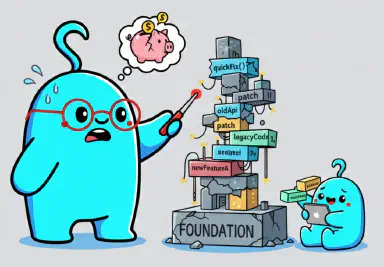
- Technical debt is the direct, measurable cost of violating these principles—and it compounds.
- Culture and tooling determine whether principles are applied by one developer or by the whole team.
Table of Contents
- Chapter 1: What Is Clean Code—and Why Does It Matter to Leadership?
- Chapter 2: The Foundational Principles
- Chapter 3: SOLID Design Principles
- Chapter 4: Code Readability and Structure
- Chapter 5: Refactoring—How Clean Code Stays Clean
- Chapter 6: Technical Debt as a Business Problem
- Chapter 7: Building a Clean Code Culture at Scale
- Frequently Asked Questions
Chapter 1: What Is Clean Code—and Why Does It Matter to Leadership?
What Is Clean Code?
Clean code is code that communicates its intent clearly, does one thing well, and can be safely changed by a developer who did not write it. It is not about style or aesthetics—it is about the structural properties that determine how much a codebase costs to maintain over time.
Robert C. Martin, whose 2008 book Clean Code remains the definitive text on the subject, describes it this way: clean code reads like well-written prose. Each element—each variable, function, class, and module—expresses a clear purpose. Nothing is surprising. Nothing requires a comment to explain what it does, because what it does is already obvious from how it is written.
The practical definition that matters for engineering leaders: clean code is code where the cost of making a change is proportional to the size of the change. In a clean codebase, a small feature requires small changes. In an unclean one, a small feature requires understanding and modifying large, tangled sections—because the code never expressed its boundaries clearly.
Why Clean Code Principles Matter Beyond the Individual Developer
The instinct is to treat clean code as a developer concern: a matter of professional pride, code review comments, or team culture. That framing understates the organizational stakes.
A 2023 McKinsey analysis of software delivery performance found that teams with explicit technical quality practices delivered features 40% faster over a 12-month horizon than teams that deprioritized quality for short-term speed. The mechanism is straightforward: clean codebases have lower change failure rates, shorter lead times for changes, and faster recovery when things go wrong. Every one of these metrics is a direct input to business velocity.
The inverse is equally measurable. Technical debt—the accumulated cost of code that violates clean code principles—is estimated by the Consortium for IT Software Quality (CISQ) to cost U.S. organizations alone over $1.5 trillion annually. That figure includes the time spent working around messy code, the bugs it generates, and the slowdown it imposes on every new feature built on top of it.
Clean code principles are the means by which engineering organizations keep that cost from compounding indefinitely.
Chapter 2: The Foundational Principles
Principle 1: Meaningful Naming
Naming is the highest-leverage act in writing clean code. A good name eliminates the need for a comment, reduces cognitive load for the reader, and encodes intent directly into the structure of the code.
The rules are straightforward but require consistent discipline to apply:
- Name variables for what they represent, not how they are stored.
invoiceDueDateInDaysis clean;dis not. - Name functions for what they do, not how they do it.
calculateMonthlyRecurringRevenue()is clean;calc()is not. - Name booleans as questions.
isEligible,hasActiveSubscription,shouldRetryRequestread naturally in conditional logic. - Name classes as nouns that represent a single concept.
InvoiceProcessoris clean;Manager,Handler, andUtilare signals that the concept has not been thought through. - Avoid abbreviations unless they are universally understood in your domain.
customerIdis cleaner thancustId;urlandidare acceptable because they are unambiguous.
The organizational implication: naming conventions belong in your definition of done and your automated linting rules—not just in the opinions of senior engineers during code review.
Principle 2: Single Responsibility
Every unit of code—every function, every class, every module—should have one reason to change. This is the Single Responsibility Principle (SRP), the first of the SOLID design principles and arguably the most consequential.
Code that violates SRP is harder to name (because it does more than one thing), harder to test (because testing one behavior requires setting up the context for all the others), and harder to change (because a change to one behavior risks breaking another). The ripple effects of an SRP violation compound as the system grows.
In practical terms: if a function requires more than a few lines to explain what it does, it probably does more than one thing. If a class imports from more than a handful of unrelated modules, it probably has more than one responsibility.
Principle 3: DRY — Don’t Repeat Yourself
The DRY principle states that every piece of knowledge should have a single, authoritative representation in a system. It is often misunderstood as “don’t copy code”—but the principle is deeper than that. Duplication of logic is duplication of risk: every copy of a business rule is a place where that rule can fall out of sync with reality.
The practical forms of duplication to watch for:
- Logic duplication: the same validation, calculation, or transformation implemented in multiple places.
- Data duplication: the same concept represented by two different data structures that must be kept in sync.
- Documentation duplication: comments that repeat what the code already says clearly—these become wrong the moment the code changes.
When duplication is removed and the extracted concept is named well, the codebase gains a vocabulary it previously lacked. That vocabulary makes subsequent changes faster and safer.
Principle 4: KISS and YAGNI
Two complementary principles govern the scope of clean code:
KISS (Keep It Simple, Stupid) holds that the simplest solution that solves the actual problem is the best solution. Complexity that is not required by the problem is complexity that someone else will have to understand, maintain, and work around.
YAGNI (You Aren’t Gonna Need It) holds that speculative functionality—code written for requirements that do not yet exist—is a form of technical debt. Every abstraction layer, every configuration option, every generalization that is not justified by a current need adds cognitive overhead and maintenance cost.
For engineering leaders, KISS and YAGNI are organizational principles as much as technical ones. They push back against over-engineering and gold-plating—habits that slow teams down and inflate codebases without delivering proportional value.
Chapter 3: SOLID Design Principles
SOLID is an acronym for five object-oriented design principles, first articulated by Robert C. Martin, that together produce code that is easier to extend, test, and maintain. Each principle addresses a specific failure mode of poorly structured code.
S — Single Responsibility Principle
As described above: every class has one reason to change. The organizational corollary is that when requirements change—and they always do—the impact of that change is localized to the classes that own the relevant responsibility.
O — Open/Closed Principle
Software entities should be open for extension but closed for modification. In practice: a well-designed system allows new behavior to be added by writing new code, not by modifying existing code. This protects stable, tested functionality from being broken by new requirements.
The most common implementation is through abstraction and polymorphism—defining interfaces that new implementations can satisfy without touching the code that consumes them.
L — Liskov Substitution Principle
If B is a subtype of A, then objects of type A can be replaced with objects of type B without breaking the system. Violations of this principle—subtypes that behave differently from what their parent type promises—are a common source of subtle, hard-to-diagnose bugs.
The practical test: if you find yourself writing if (x instanceof SomeSubclass) to handle special cases, Liskov is likely being violated somewhere in the hierarchy.
I — Interface Segregation Principle
Clients should not be forced to depend on interfaces they do not use. Large, monolithic interfaces create coupling between unrelated behaviors—changing one part of the interface forces changes in all consumers, even those that do not care about the part that changed.
The fix is to split large interfaces into smaller, more focused ones. Each client depends only on the methods it actually needs.
D — Dependency Inversion Principle
High-level modules should not depend on low-level modules; both should depend on abstractions. This is the principle that makes systems testable: when dependencies are expressed as interfaces rather than concrete implementations, they can be replaced with test doubles in unit tests and with alternative implementations in production.
Dependency injection frameworks operationalize this principle at the application level, but the discipline of depending on abstractions rather than concretions applies at every layer of the system.
| Principle | Core Rule | Primary Benefit |
|---|---|---|
| Single Responsibility | One reason to change per class | Localizes impact of change |
| Open/Closed | Extend without modifying | Protects stable functionality |
| Liskov Substitution | Subtypes honor parent contracts | Prevents substitution bugs |
| Interface Segregation | Small, focused interfaces | Reduces unnecessary coupling |
| Dependency Inversion | Depend on abstractions | Enables testability and flexibility |
Chapter 4: Code Readability and Structure
Functions: Small, Focused, Named for What They Do
Clean functions share three properties: they are short, they do one thing, and their name makes what they do obvious without reading the body.
The length guideline that holds up in practice: if a function does not fit on a screen, it is a candidate for splitting. If splitting it produces smaller functions that are hard to name, the original function was likely handling multiple concerns that need to be separated at a higher level.
Argument count matters too. Functions with more than three arguments are hard to call correctly and hard to test comprehensively. When a function requires many inputs, it often signals that those inputs belong together as a named concept—a struct, a value object, a parameter group.
Comments: Express Intent in Code, Not Prose
The clean code position on comments is often misunderstood. It is not that comments are bad. It is that a comment compensating for code that does not express its intent clearly is a missed opportunity—the intent should be in the code itself.
The comments worth writing:
- Why, not what. If a decision was made for non-obvious reasons—a regulatory requirement, a performance trade-off, a workaround for a third-party bug—a comment explaining the reasoning is valuable.
- Legal and licensing notices, where required.
- Public API documentation, where consumers of an interface need more context than the signature provides.
The comments to eliminate: those that restate what the code already says, those that track history that version control already tracks, and those that mark sections of a function that should instead be extracted into named sub-functions.
Error Handling as a First-Class Concern
Error handling is where code readability most commonly degrades. A function that mixes business logic with defensive checks and recovery paths becomes difficult to read and difficult to test.
The clean approach: treat error handling as a separate concern. Use exceptions rather than error return codes. Write functions that either complete their task or throw a meaningful exception—not functions that return null and leave the caller to figure out what went wrong. And never swallow exceptions silently; silent failure is one of the most expensive patterns in software maintenance.
Formatting and Consistency
Consistent formatting does not make code correct, but inconsistent formatting makes correct code harder to read. Formatting decisions—indentation, line length, brace placement, blank line usage—should be settled once, automated with a formatter, and never discussed in code reviews again.
The goal is that the entire codebase reads as if written by a single author. Not because one person wrote it, but because the team agreed on and enforces a shared style.
Chapter 5: Refactoring—How Clean Code Stays Clean
What Refactoring Is (and Is Not)
Refactoring is the discipline of improving the internal structure of existing code without changing its observable behavior. It is not rewriting, not optimization, and not adding features. It is cleaning.
Without continuous refactoring, even clean code degrades. Requirements change, systems grow, and the understanding of the problem domain deepens over time. Code written for yesterday’s understanding of the problem needs to be updated to reflect today’s. That is what refactoring does.
The Boy Scout Rule
Robert C. Martin’s formulation: leave the code better than you found it. Not perfectly clean—just better. A better variable name, a shorter function, a removed duplication. Applied consistently across a team, the Boy Scout Rule makes the codebase incrementally cleaner with every change rather than incrementally messier.
The organizational implementation: make “leave it better” part of the definition of done. Not as an optional extra, but as a standard expectation of every pull request.
When to Refactor
The instinct to refactor should be triggered by three situations:
Before adding a feature: if the current structure makes the feature hard to add, improve the structure first. This is the “preparatory refactoring” pattern—making the change easy before making the easy change.
After passing a test: once a test is passing, the code is correct. Now make it clean. The test provides the safety net that makes refactoring safe.
During code review: code review is the natural point at which the team’s shared standards are applied. Refactoring suggestions are not pedantry—they are maintenance investments.
Refactoring Requires a Safety Net
Refactoring without tests is not refactoring—it is gambling. The ability to make structural changes with confidence depends entirely on having a test suite that will catch any behavioral regression immediately.
This is the practical reason why clean code and test-driven development are inseparable. TDD produces tests as a by-product of development; those tests are what make the codebase safely refactorable for the rest of its life.
Chapter 6: Technical Debt as a Business Problem
Defining Technical Debt
Ward Cunningham, who coined the term in 1992, used a financial metaphor deliberately: technical debt is borrowed time. Cutting corners to ship faster is the loan; the interest is the extra effort required to work in and around the messy code thereafter.
Like financial debt, technical debt is not inherently bad. A deliberate, short-term compromise—made consciously, documented, and planned to be repaid—can be a rational business decision. What is irrational is debt that is invisible, untracked, and never repaid. That is not a loan; it is a slow structural collapse.
The Compounding Cost of Violations
Each clean code principle, when violated consistently, produces a specific category of debt:
- Naming violations produce comprehension debt: every developer who touches the code must spend time figuring out what it means.
- SRP violations produce coupling debt: changes to one behavior break unrelated behaviors, multiplying the cost and risk of every change.
- DRY violations produce synchronization debt: the same knowledge exists in multiple places, and keeping those places in sync requires effort on every update.
- Missing tests produce refactoring debt: without tests, the codebase cannot be safely improved, so it can only get worse over time.
Making Debt Visible and Manageable
The single most impactful thing an engineering leader can do for long-term delivery capacity is make technical debt visible and treat it as a first-class backlog item—not a vague acknowledgment that “we should clean things up someday.”
A practical technical debt management approach:
- Log debt explicitly: each known debt item gets a ticket with a description, an owner, and an estimated cost-to-fix.
- Prioritize by delivery impact: debt that is slowing current feature work is higher priority than debt in rarely-touched areas.
- Allocate capacity: reserve 15–20% of sprint capacity for debt repayment as a standing policy, not an occasional exception.
- Track trends: measure indicators like test coverage, code complexity scores, and deployment frequency. Trends in these metrics tell you whether debt is growing or shrinking.
When debt is visible and tracked, it becomes a business conversation. A debt backlog with quantified delivery impact gives leadership the information to make deliberate trade-off decisions—rather than discovering the problem when a critical system becomes effectively unmaintainable.
Chapter 7: Building a Clean Code Culture at Scale
Why Individual Discipline Is Not Enough
Most engineering teams contain developers who know these principles and apply them in their own work. The gap between “some developers write clean code” and “the team writes clean code” is cultural and organizational, not technical.
Clean code at scale requires that principles be shared, enforced, and treated as non-negotiable quality standards—not as the personal preferences of senior engineers that junior engineers are gradually expected to absorb.
Shared Standards
The foundation of a clean code culture is explicit agreement on what clean code looks like in your specific codebase. That means:
- A style guide that resolves formatting and naming decisions once, so they are never relitigated in code review.
- A definition of done that includes code quality criteria—not just “tests pass” but “no new technical debt introduced without a logged ticket.”
- Automated enforcement: linters, formatters, and static analysis tools that catch violations before they reach review.
Automation is critical here. Standards that depend on human vigilance in every review will be applied inconsistently. Standards backed by tooling are applied uniformly—and their enforcement costs nothing in review bandwidth.
Code Review as a Learning Tool
Code review is one of the most powerful mechanisms for spreading clean code norms across a team—when it is structured as a learning conversation rather than a gatekeeping exercise.
Reviews that identify violations without explaining the principle leave developers guessing about what good looks like. Reviews that explain the reasoning—“this function does two things; here is how I would split it and why”—build shared vocabulary and shared standards over time.
The cultural target is for clean code feedback to come not just from senior engineers but from everyone on the team—because everyone understands the principles and applies them consistently.
Psychological Safety for Quality Conversations
Teams cannot sustain clean code culture without the psychological safety to say “this is not ready.” Developers who feel that raising quality concerns will slow them down, create conflict, or reflect poorly on them will stop raising them.
The leadership role is to make quality concerns welcome—to model the behavior of slowing down to do something right, to visibly prioritize debt repayment alongside feature delivery, and to treat code that ships with known quality problems as a decision that was made, not a standard that was met.
Measuring Engineering Health
Clean code culture requires visibility. Metrics that make code quality tangible to non-technical stakeholders:
| Metric | What It Measures | Why It Matters |
|---|---|---|
| Test coverage | Percentage of code covered by automated tests | Indicates refactorability and safety net strength |
| Cyclomatic complexity | Number of independent paths through code | Predicts maintenance difficulty and defect density |
| Technical debt ratio | Estimated remediation time vs. development time | Quantifies accumulated quality debt |
| Deployment frequency | How often code is deployed to production | Indicator of overall engineering health and flow |
| Change failure rate | Percentage of deployments causing incidents | Reflects code quality and testing discipline |
These metrics do not replace engineering judgment, but they make quality trends visible to everyone in the organization—not just the engineers who live in the codebase.
Frequently Asked Questions
What are clean code principles?
Clean code principles are a set of disciplines for writing software that is readable, maintainable, and easy to change. They cover naming, function design, avoiding duplication, SOLID object-oriented design, code readability, and continuous refactoring. Together they define the structural properties that separate software that sustains delivery velocity from software that slows it down over time.
Who defined clean code principles?
The clean code principles most widely referenced today were articulated by Robert C. Martin (Uncle Bob) in his 2008 book Clean Code: A Handbook of Agile Software Craftsmanship. Martin drew on earlier work by Kent Beck (Extreme Programming), Ward Cunningham (who coined “technical debt”), and the broader software craftsmanship movement. The SOLID acronym was coined by Michael Feathers and popularized by Martin.
What is the most important clean code principle?
Meaningful naming is often cited as the single highest-leverage principle because it affects every level of abstraction and is the primary mechanism by which code communicates intent. In practice, Single Responsibility is arguably the most consequential structural principle: code that does one thing is testable, replaceable, and safe to change in ways that multi-purpose code is not.
How do clean code principles relate to technical debt?
Technical debt is the accumulated cost of violating clean code principles. Each violation—an unclear name, a function that does too much, duplicated logic, a missing test—imposes a small ongoing cost on every developer who works with that code thereafter. Those costs compound. Managing technical debt means tracking violations explicitly, prioritizing their remediation, and applying clean code principles consistently enough that new debt does not accumulate faster than old debt is repaid.
Can clean code principles be applied to legacy codebases?
Yes—but incrementally, not wholesale. The Boy Scout Rule is the entry point: make every section of code you touch slightly cleaner than you found it. Introduce tests as a safety net before refactoring existing logic. Use the Strangler Fig pattern to replace problematic components over time without a full rewrite. Legacy codebase improvement is a long game, but consistent application of these principles produces measurable results within 6–12 months.
Do clean code principles slow teams down?
In the very short term, applying clean code principles adds time to individual tasks—writing a clear name takes longer than writing a short one, splitting a function takes longer than leaving it. Over a 6–12 month horizon, clean codebases consistently outperform messy ones on all delivery metrics: feature lead time, defect rate, deployment frequency, and onboarding speed. The McKinsey Developer Velocity research found that high-quality engineering practices correlate directly with faster delivery. Clean code is not slow—accumulated technical debt is slow.
How do you enforce clean code principles across a team?
Through a combination of explicit shared standards (style guides, definitions of done), automated tooling (linters, formatters, static analysis, test coverage thresholds), and code review culture that treats quality feedback as a normal, expected part of the review process. The key is moving enforcement from individual willpower to systematic tooling—standards that depend on human vigilance in every review will be applied inconsistently.
What is the relationship between clean code and software craftsmanship?
Software craftsmanship is the professional philosophy; clean code principles are the primary technical expression of that philosophy. A craftsman—in the sense used by the 2009 Manifesto for Software Craftsmanship—writes well-crafted software, steadily adds value, and treats code quality as a professional obligation rather than an optional extra. Clean code principles are the specific, actionable disciplines through which that commitment is practiced daily.
Key Takeaways
Clean code principles are not abstractions—they are specific, teachable disciplines with measurable organizational consequences.
Meaningful naming and single responsibility are the entry points: they cost relatively little to apply and have an outsized impact on code readability and maintainability. DRY and SOLID design principles build on that foundation to produce systems that remain changeable as requirements evolve. Continuous refactoring is the practice that keeps clean code clean over time. Technical debt management is how organizations make these principles visible and governable at the leadership level.
The thread connecting all of these is intent: code that clearly expresses what it does, why it does it, and where its boundaries are. That clarity is not a luxury—it is the structural property that determines how much a codebase costs to operate and how fast the team that operates it can move.
What’s Next?
If these principles resonate and you are thinking about where to start in your own organization, the practical entry points are:
- Audit your definition of done: does it include code quality criteria, or does it stop at “tests pass”?
- Inventory your tooling: are linting, formatting, and static analysis automated in your CI pipeline?
- Make debt visible: do you have a technical debt backlog with estimated delivery impact?
Bytecraft works with organizations to build the practices, standards, and culture that make clean code the default. If your team is carrying technical debt that is slowing delivery and you want a structured path forward, we can help.
Related reading: What Is Software Craftsmanship? | How to Write Clean Code | Building Sustainable Development Practices at Metso