Developer Mentoring: Why Building Software Well Requires Building People First
Developer mentoring is the practice of pairing experienced engineers with less experienced ones to transfer not just technical knowledge, but judgment. The kind of judgment that decides when to refactor, how to decompose a problem, where to draw a module boundary, and whether the thing you’re building solves the actual problem. This judgment doesn’t live in documentation or tutorials. It lives in people who’ve spent years making decisions and watching the consequences unfold.
Most organizations treat developer mentoring as a nice-to-have. Something that happens informally when a senior engineer has spare time, which is to say, almost never. That’s a mistake that compounds over time, and in the age of AI-assisted development, it compounds faster than ever.
The Multiplier Problem
AI is a multiplier of your current state. It doesn’t fix broken processes or compensate for missing skills. If your team writes clean, well-structured code guided by clear architectural thinking, AI tools accelerate that quality. If your team lacks the discipline to review, test, and question what they produce, AI accelerates the mess.
This observation, drawn from real client engagements, frames why mentoring has become urgent rather than optional. One team working in a feature factory mode discovered this firsthand: code and features appeared quickly with AI assistance, but the rest of the organization couldn’t keep pace. Bugs surfaced. Pull requests piled up in review queues. Context-switching increased and cognitive load grew. The speed of code production had outrun the team’s capacity for code comprehension.
The lesson wasn’t that AI tools are dangerous. The lesson was that without the human skills of review, architectural judgment, and disciplined testing, speed becomes a liability. Those human skills don’t emerge spontaneously. Someone has to teach them, model them, and reinforce them until they become habits. That’s what developer mentoring does.
What Developer Mentoring Actually Covers
Developer mentoring in a professional software organization isn’t tutoring. It isn’t explaining how a for-loop works or walking someone through a framework’s getting-started guide. It covers the tacit knowledge that experienced engineers carry and that courses can’t transmit.
Consider the Software Craftsmanship movement’s core insight: programming is a craft, not an assembly line. The 2008 Manifesto for Software Craftsmanship articulated what many developers already felt. Well-crafted software matters more than merely working software. Steadily adding value matters more than reacting to change. A community of professionals matters more than individuals working in isolation. Productive partnerships matter more than transactional customer relationships. These values require practice and feedback from someone who embodies them. They require mentoring.
In concrete terms, mentoring in this tradition covers architecture decisions and how to reason about tradeoffs rather than defaulting to the first pattern that compiles. It covers test-driven development as a thinking discipline, not just a testing technique. It covers the ability to read a codebase critically, question assumptions, and push back on generated code that passes tests but misses the point. It covers the soft skills of communicating technical tradeoffs to non-technical stakeholders, estimating work honestly, and managing scope without losing sight of long-term quality.
Extreme Programming (XP) practices sit at the heart of this. Pair programming, collective code ownership, continuous integration, small releases, and the red-green-refactor cycle of TDD all depend on a team culture that values quality over throughput. Junior developers don’t absorb this culture by reading about it. They absorb it by working alongside someone who practices it daily.
The Competence Question: Knowing Where You Stand
Before you can build a mentoring program, you need to understand what your team actually needs. This is where a software development maturity assessment becomes essential.
A maturity assessment evaluates your team’s practices across multiple dimensions: governance and strategic alignment, planning and scope management, development process and practices, quality assurance, architecture and design, risk management, continuous improvement, stakeholder communication, and learning culture. At each level, it distinguishes between teams that are reactive and unstructured and teams that are proactive and continuously improving.
Take quality assurance as one dimension. A team at the lowest maturity level checks quality mainly at the end of development, during QA or user acceptance testing, with minimal test automation. A team at the highest maturity level embeds quality as a shared mindset from ideation to deployment, using shift-left testing, automated quality gates, TDD, observability, and continuous feedback loops. The gap between these two levels isn’t primarily a tooling gap or a budget gap. It’s a skills and culture gap. Closing it requires people learning from people, not just adopting tools.
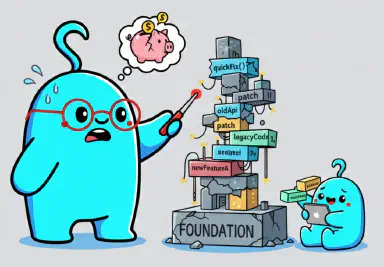
Or consider how teams handle technical debt. A reactive team identifies debt only when it causes bugs or performance problems and fixes it on an ad-hoc basis with limited documentation. A proactive team uses automated code quality tools integrated into the CI/CD pipeline, schedules refactoring time in every sprint, documents known debt with impact-based prioritization, and enforces coding standards through reviews to prevent new debt from accumulating. Moving from reactive to proactive requires developers who understand why these practices matter and how to implement them. It requires mentors.
The competence matrix complements the maturity assessment by mapping what individual engineers know and can do at each career level. It turns vague expectations into specific, observable behaviors. When a junior engineer knows that reaching the next level means leading architectural discussions or mentoring others, growth becomes intentional rather than accidental.
AI-Assisted Development Makes Mentoring Harder and More Necessary
AI coding tools introduce a new category of challenge for developer growth. The traditional path for junior engineers, starting with simple, repetitive tasks that gradually build deeper expertise, is being automated. A 2024 Stack Overflow Developer Survey found that 68% of developers with less than two years of experience worry that AI will hinder their ability to learn fundamentals. That concern isn’t unfounded.
When an AI agent generates code that passes tests, a junior developer without mentoring has no way to evaluate whether the code is well-structured, maintainable, or aligned with the broader architecture. They learn to accept output rather than interrogate it. Over time, this creates a new form of technical debt that’s qualitatively different from traditional debt. AI-generated technical debt manifests as duplicated code snippets, inconsistent quality, and hidden security vulnerabilities that accumulate because the model optimized for immediate output at the expense of long-term sustainability.
Experienced developers working with AI tools have learned to treat AI suggestions as starting points, not finished products. They’ve learned that test-driven development in an AI-assisted workflow requires separating test writing and implementation into different contexts, because the model’s context window creates interference. If you give an agent the instruction to write tests and then implement the feature, the test-writing phase dominates the context and the implementation ends up optimized for passing tests rather than fulfilling requirements. If you reverse the order, the tests get written with knowledge of the implementation’s internal logic and only verify the happy path. Separating these into distinct sessions produces better results.
None of this is intuitive. Junior developers won’t discover it through trial and error before the damage is done. Someone needs to teach them how to work alongside AI productively, which models to use for which tasks, when to trust the output and when to start over, and how to maintain healthy skepticism without becoming paralyzed. That’s a mentoring function.
What Effective Developer Mentoring Looks Like
Mentoring that works isn’t ad-hoc conversations when someone gets stuck. It has structure. Individual mentoring sessions give developers dedicated time to work through technical challenges and discuss career development. Day-to-day sparring provides immediate support for architectural questions and implementation decisions. A weekly learning cadence maintains structured goals and review cycles so that progress stays visible. Curated learning materials give mentees access to proven patterns and practices rather than leaving them to sift through an ocean of varying-quality online content. Regular alignment with stakeholders ensures that the mentoring program serves business goals, not just individual curiosity.
This structure acknowledges that effective mentoring is expensive. It requires experienced engineers to spend significant time teaching rather than producing. Organizations that treat mentoring as a cost rather than an investment misunderstand the economics. The cost of not mentoring is slower onboarding, higher attrition, inconsistent code quality, and a growing burden of technical debt that someone will eventually have to pay down. In the AI era, where code production is cheap and code comprehension is expensive, that bill arrives faster.
The Organizational Shift
When AI tools increase the rate of code and feature production, review and testing become proportionally more important. Time must shift from writing code to evaluating code. Organizations that recognize this are reallocating resources toward three areas in their development pipelines: feature specification, code review, and testing and quality assurance.
This reallocation doesn’t happen by decree. It happens when teams internalize why these activities matter, and that requires a culture built through mentoring. Consider what a mature team does with retrospectives. At the lowest maturity level, retrospectives happen because someone scheduled them. The same surface-level feedback repeats every sprint, nothing changes, and the scrum master runs the meeting alone. At the highest level, the team adjusts its own processes continuously. Retrospectives become high-value, adaptive sessions where leadership rotates, experiments are encouraged, and improvements are measurable. Teams don’t jump from the first state to the second by reading a book about agile practices. They get there by having someone show them what good looks like and hold them accountable for getting closer to it.
The same applies to knowledge sharing more broadly. In organizations where knowledge lives inside individuals or isolated teams, every departure creates a crisis and every new hire takes months to become productive. In organizations where pair programming, documentation, and communities of practice are actively promoted, knowledge becomes resilient. Building that culture is, again, a mentoring challenge.
Measuring Progress
A mentoring program without measurement is just a series of conversations. Effective programs track outcomes that connect to business value. Cycle time with quality tells you whether the team is getting faster without getting sloppy. Production defect rates reveal whether quality practices are actually working. Time to comprehend and modify code measures whether the codebase is becoming more or less maintainable. Test quality and coverage relevance show whether tests are catching real problems or just inflating metrics.
These measurements also expose when AI-generated code is creating hidden problems. If review cycle counts are climbing on AI-assisted pull requests, that signals poor comprehensibility or high integration complexity. If certain files keep generating recurring bugs after commits, that pattern indicates silent degradation. A mentoring program can use these signals to focus effort where it matters most, building the specific skills that prevent these patterns from becoming permanent.
Frequently Asked Questions
What is developer mentoring?
Developer mentoring is the practice of pairing experienced engineers with less experienced ones to transfer tacit knowledge — the judgment that decides when to refactor, how to decompose a problem, and whether what you’re building solves the actual problem. It goes beyond technical skills to cover architectural thinking, communication, and professional practices.
How is developer mentoring different from training courses?
Training delivers codified knowledge through courses, tutorials, and documentation. Mentoring transfers tacit knowledge — the judgment that only develops through practice and feedback from someone who embodies it. In software development, most of what separates senior from junior engineers is tacit and can only be learned through mentoring.
How long does a developer mentoring program take to show results?
Most teams see measurable improvements within 3–6 months: reduced review cycle times, fewer production defects, and faster onboarding of new hires. Cultural shifts — like proactive technical debt management and continuous improvement through retrospectives — typically take 6–12 months to become durable habits.
How do you measure the ROI of developer mentoring?
Track four metrics: cycle time with quality (faster delivery without increased defects), production defect rates, time to comprehend and modify unfamiliar code, and test coverage relevance. These connect mentoring investment to business value more directly than measuring lines of code or velocity points.
What makes AI-era developer mentoring different?
AI tools automate the repetitive tasks that traditionally built junior developers’ foundational skills. This creates a new mentoring challenge: teaching developers how to work alongside AI productively — which models to use for which tasks, when to trust output and when to start over, and how to maintain healthy skepticism without becoming paralysed.
Connecting Mentoring to Business Outcomes
Developer mentoring isn’t philanthropy. It’s a mechanism for reducing recruitment risk, accelerating onboarding, building retention, and raising the baseline quality of everything a team produces. Organizations that hire junior and mid-level developers and surround them with structured mentoring from senior engineers create a pipeline of internally grown talent that understands the codebase, the architecture, and the organizational context. This is more durable and more cost-effective than perpetually competing for scarce senior hires on the open market.
The model works particularly well when mentoring is embedded into real delivery rather than treated as a separate training program. When a mentor reviews pull requests alongside a mentee, both get productive work done while skills transfer happens naturally. When a mentor helps a junior developer navigate a multi-repository environment with shared context files and cross-service dependencies, the mentee learns not just how to make the change but how to think about systems. The work gets done and the team gets stronger simultaneously.
For organizations evaluating where they stand and what to invest in, a maturity assessment provides the diagnostic foundation. It reveals not just what processes exist but how deeply they’re understood and practiced. It surfaces whether quality is a shared mindset or a bottleneck, whether improvement is continuous or ritualistic, and whether the team is growing or standing still.
Bytecraft’s open-source Software Development Maturity Assessment provides one structured way to start that diagnostic conversation. It’s designed for teams, tech leads, and stakeholders who want an honest picture of where they stand and where the gaps are. From there, whether you close those gaps through internal effort, through a dedicated mentoring engagement, or through a combined hiring and mentoring model like BytePath, the important thing is that the investment goes into people, not just tools.