How to Build a Software Craftsmanship Culture in Your Team
Most engineering teams have at least a few developers who care deeply about code quality, apply clean code principles consistently, and push back on shortcuts. The challenge is not finding those people. The challenge is making their standards the team’s standards—systematically, durably, across every pull request, every sprint, and every new hire.
A software craftsmanship culture is one where technical excellence is not the personal project of your senior engineers but the shared expectation of the whole team. Getting there is not a matter of inspiration—it is a matter of deliberate organizational design.
This guide gives you the steps to build it.
Key takeaways
- Craftsmanship culture is built through systems and habits, not individual talent alone.
- The foundation is shared standards enforced by tooling—not willpower or code review heroics.
- Psychological safety is a prerequisite: teams that cannot say “this isn’t ready” cannot sustain quality.
- Mentorship and deliberate practice are how standards spread across the team over time.
- Progress is measurable: test coverage, complexity scores, deployment frequency, and change failure rate all move when culture changes.
What You’ll Need
Organizational prerequisites:
- Leadership commitment to treat quality as a delivery input, not a nice-to-have
- Sprint capacity to allocate to non-feature work (10–20%)
- Buy-in from at least one senior engineer to champion the change
Time required: Cultural change takes 12–24 months to become self-sustaining. The first 90 days establish the foundation; meaningful metric movement typically appears at the 6-month mark.
Skill level: Organizational and leadership, not purely technical.
Why Craftsmanship Culture Matters
Before the steps: the business case is real and quantifiable.
A 2023 McKinsey analysis found that teams with explicit technical quality practices delivered features 40% faster over a 12-month horizon than teams that deprioritized quality for short-term speed. Developer productivity—measured in sustainable throughput, not just lines of code—is directly correlated with the health of the codebase those developers work in.
Craftsmanship culture is how you build and maintain that health at the team level, not just the individual level.
Step 1: Establish Explicit Shared Standards
The first failure mode of craftsmanship culture is leaving quality to individual interpretation. When each developer applies their own judgment about what “good enough” means, the result is a codebase with pockets of excellence surrounded by inconsistency.
How to do it:
- Convene a working session with your senior engineers to draft a team style guide and definition of done that includes code quality criteria—not just “tests pass” and “no merge conflicts.”
- Agree on naming conventions, file structure standards, and code review expectations in writing.
- Automate the parts that can be automated: linting rules, formatters, and static analysis thresholds go into the CI pipeline so they are enforced on every commit without human oversight.
- Treat the standards as living documents—review them quarterly and update them as the team’s understanding matures.
Pro tip: Start with the standards that generate the most friction in code reviews. If the same formatting argument recurs every week, that is the first thing to automate away.
You’ll know it’s working when: code review comments shift from style debates to design and logic discussions.
Step 2: Create Psychological Safety for Quality Conversations
Shared standards mean nothing if developers cannot surface quality concerns without political risk. Teams where raising “this code isn’t ready” slows someone’s delivery, creates conflict, or gets ignored will stop raising it.
How to do it:
- Model the behavior yourself as a leader: slow down publicly when something is not right. When you deprioritize a deadline to address a quality issue, say so explicitly and explain why.
- Separate quality feedback from performance feedback. A developer who writes messy code is not failing—they are operating without sufficient standards or support.
- Make it normal to say “I don’t understand this code” in reviews. Incomprehensibility is a quality issue, not a reviewer’s shortcoming.
- When a quality shortcut ships under deadline pressure, log it as technical debt immediately and visibly—reinforcing that the compromise was a decision, not a standard.
Common mistake: Treating psychological safety as a culture initiative separate from engineering. It is not. It is the operating condition that determines whether your standards are actually applied.
Step 3: Build Mentorship Into the Workflow
Craftsmanship standards spread person-to-person through pairing, review, and direct conversation—not through documentation alone. The senior engineers on your team carry the most concentrated knowledge of what good looks like; building mentorship structures into the workflow is how that knowledge transfers.
How to do it:
- Introduce structured pair programming for complex work and onboarding. Pairing is the fastest mechanism for transferring craftsmanship instincts—faster than documentation, faster than lectures.
- Assign code review ownership deliberately: junior and mid-level developers should receive reviews from engineers whose code quality they aspire to, not just whoever is available.
- Run internal tech talks or code walkthroughs once or twice per month—not on new technologies, but on real code from your own codebase. Show what a refactoring decision looked like before and after, and why it matters.
- Create explicit apprenticeship milestones for new hires: what does “junior,” “mid,” and “senior” craftsmanship look like in your team, and how do developers progress?
Pro tip: The most effective mentorship happens during code review when the reviewer explains the why, not just the what. A comment that says “extract this to a function” teaches nothing. A comment that says “extracting this makes it testable independently and signals that this is a distinct responsibility” teaches a principle.
Step 4: Allocate Capacity for Deliberate Practice
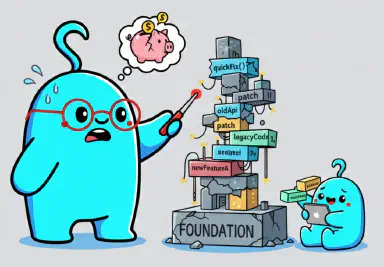
The most common way craftsmanship culture fails is capacity starvation. Teams that intend to refactor, pay down technical debt, and invest in quality but never protect capacity for those activities will always find that feature pressure wins.
How to do it:
- Reserve 15–20% of sprint capacity for technical excellence work as a standing allocation—not negotiated sprint by sprint.
- Maintain a visible technical debt backlog with estimated delivery impact. Debt that is not in the backlog does not get prioritized; debt with no estimated impact does not get understood.
- Apply the Boy Scout Rule as a team norm: every piece of code touched in a sprint should be left slightly cleaner than it was found—a better name, a shorter function, a removed duplication.
- Schedule dedicated refactoring sessions for high-traffic areas of the codebase that have accumulated the most debt. Treat these like features: with tickets, acceptance criteria, and review.
Common mistake: Framing refactoring as “paying down debt” only. The better frame for leadership conversations is “reducing the cost of future features.” Debt repayment is a maintenance concept; delivery speed is a business concept.
Step 5: Measure Engineering Health Visibly
Culture change that is not measured is invisible. Measuring the right indicators makes progress concrete for the team and legible to non-technical stakeholders.
Track these metrics:
| Metric | What it signals | Target direction |
|---|---|---|
| Test coverage | Refactorability and safety net strength | Increasing |
| Cyclomatic complexity | Maintenance difficulty and defect risk | Decreasing |
| Deployment frequency | Engineering health and flow | Increasing |
| Change failure rate | Code quality and testing discipline | Decreasing |
| Mean time to recovery | System resilience and operational maturity | Decreasing |
Review these metrics in a monthly engineering health check—not as a performance review, but as a team retrospective on the codebase itself. What moved? What did not? What is the next highest-impact area to address?
Pro tip: Make the metrics visible to the whole team on a shared dashboard, not just to management. Developers who can see the trend lines develop a shared sense of ownership over them.
What to Do If Progress Stalls
Problem: Standards are agreed but not applied consistently
Solution: The gap is almost always tooling, not intent. If a standard is not automated, it will not be consistently enforced. Add it to the linter, the formatter, or the CI gate.
Problem: Senior engineers are the only ones raising quality concerns
Solution: This indicates that psychological safety exists for senior engineers but not yet for others. Explicitly invite quality feedback from junior and mid-level developers in reviews. Recognize and thank it when it appears.
Problem: Technical debt keeps growing despite backlog and allocation
Solution: The allocation is being consumed by firefighting rather than proactive improvement. This is a symptom of insufficient test coverage—without tests, every change carries risk, and risk gets managed reactively. Prioritize test coverage in high-change areas above all other debt work.
Frequently Asked Questions
How long does it take to build a software craftsmanship culture?
Cultural change in software teams typically takes 12–24 months to become self-sustaining. The first three months establish shared standards and tooling. Months three through twelve embed the practices through mentorship and repetition. By month eighteen, the standards should be reproducing themselves—new team members absorbing them naturally through the workflow rather than requiring explicit instruction.
What is the difference between craftsmanship culture and just having good coding standards?
Coding standards are a written agreement. Craftsmanship culture is the organizational condition in which those standards are actually applied, questioned, improved, and passed on. Standards without culture are documents; culture is what makes them live.
How do you balance craftsmanship investment with delivery pressure?
The honest answer: you do not balance them, you reframe them. Delivery pressure is the short-term view; craftsmanship investment is what sustains delivery capacity over time. The McKinsey data cited above is the business case: quality teams deliver faster, not slower, over any horizon longer than a few sprints. The leadership task is making that time horizon visible to stakeholders who are measuring the next quarter.
Conclusion
Building a software craftsmanship culture is not a one-time initiative—it is an ongoing organizational investment in the practices, standards, and habits that determine how fast and how reliably your engineering team can deliver value over time.
The steps are concrete: establish shared standards backed by tooling, create safety for quality conversations, build mentorship into daily work, protect capacity for technical excellence, and measure progress visibly. None of these are complicated. All of them require consistent leadership commitment over a sustained period.
If your organization is ready to make that investment and wants a structured path to get there, Bytecraft works with engineering teams to build exactly this—practices and culture that make technical excellence the default, not the exception.
Talk to Bytecraft → | Explore our services →
Related reading: What Is Software Craftsmanship? | Clean Code Principles Every Developer Should Know | How to Write Clean Code