How to Write Clean Code: A Practical Guide for Engineering Leaders
Clean code is code that another developer can read, understand, and safely change—without needing to ask the author what it means. It is the foundation of maintainable software and the single most reliable lever for reducing long-term technical debt.
For CTOs and engineering leaders, clean code is not an aesthetic preference. It is an operational decision. Teams that consistently write clean code ship features faster, onboard new hires more quickly, and spend less time firefighting regressions.
Key takeaways
- Clean code is defined by readability and changeability, not cleverness.
- The principles are simple; consistent application across a team is the hard part.
- Technical debt is the direct cost of code that is not clean—and it compounds.
- Culture and tooling matter as much as individual skill.
What Is Clean Code?
Robert C. Martin’s definition remains the most useful: clean code does one thing well, expresses intent clearly, and has no surprises. It passes all tests, contains no duplication, and is written so that the next developer—likely you, six months from now—can work with it confidently.
The opposite of clean code is not “messy code.” It is expensive code. Code that slows down every feature, multiplies every bug fix, and raises the risk of every deployment.
Step 1: Use Names That Tell the Truth
Naming is the highest-leverage clean code practice. A well-named variable, function, or class eliminates the need for a comment.
Apply these rules across your codebase:
- Name variables for what they represent, not how they are stored.
userAgeInYearsbeatsint1. - Name functions for what they do, not how they do it.
calculateMonthlyRevenue()beatsprocess(). - Name booleans as questions.
isEligible,hasPermission,shouldRetry. - Avoid abbreviations unless they are universally understood in your domain (e.g.,
id,url).
Bad naming is invisible to the developer writing the code—and immediately obvious to everyone else reading it. Establish naming conventions in your team’s definition of done, not in ad-hoc code reviews.
Step 2: Write Functions That Do One Thing
The single responsibility principle applies at every level of abstraction, including individual functions. A function that does one thing is easy to name, easy to test, and easy to replace.
In practice:
- If you cannot name a function without using “and,” it does too much.
- Keep functions short—ideally under 20 lines. If you are scrolling to understand a function, it needs to be split.
- Limit function arguments to three or fewer. More than three is a signal that a concept—a struct, an object, a parameter group—is missing.
The discipline here is organizational. Individual developers know these rules. The gap is enforcement: code reviews that actually catch violations and a culture where splitting a function is treated as progress, not pedantry.
Step 3: Eliminate Duplication Ruthlessly
Duplicated logic is duplicated risk. Every copy of a business rule is a place where that rule can fall out of sync.
The DRY principle (Don’t Repeat Yourself) is not about avoiding identical lines of code. It is about ensuring that every piece of knowledge has a single, authoritative representation in the system.
Watch for these patterns:
- Identical or near-identical code blocks copied across modules
- Business rules encoded in multiple places (e.g., the same validation logic in the API layer and the database layer)
- Constants defined more than once
When you find duplication, extract it. Name the extraction well—you are not just reducing lines, you are surfacing a concept the codebase was previously hiding.
Step 4: Refactor Continuously, Not Occasionally
Refactoring is the practice of improving code structure without changing its behavior. It is how clean code stays clean over time. Teams that treat refactoring as a separate project—something to do “when we have time”—accumulate technical debt that eventually makes the codebase untouchable.
Build refactoring into the workflow:
- Apply the Boy Scout Rule: leave every file you touch slightly cleaner than you found it.
- Reserve 10–15% of sprint capacity explicitly for refactoring and code quality work.
- Use the Strangler Fig pattern for larger clean-up: wrap legacy behavior, replace it incrementally, never rewrite everything at once.
Refactoring requires a safety net. Without tests, you cannot refactor confidently—you are just moving risk around. This is why clean code and test-driven development are inseparable in practice.
Step 5: Make Technical Debt Visible
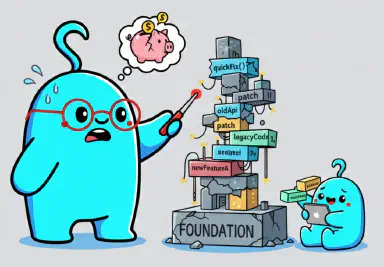
Technical debt is the gap between the code you have and the code that would be clean. Every codebase carries some. The problem is not debt itself—it is invisible debt.
Create a technical debt backlog:
- Log debt items the same way you log features: with a description, an owner, and an estimated cost to fix.
- Prioritize debt by impact on velocity, not by age or developer frustration.
- Review the backlog in planning. Debt that never appears in planning never gets addressed.
When technical debt is visible, it becomes a business conversation. CTOs who can show a debt backlog with associated delivery risk are having a different conversation with the board than those who cannot.
Step 6: Enforce Standards with Tooling, Not Willpower
Code quality standards that live only in documentation do not survive contact with deadline pressure. Automate enforcement wherever possible.
Minimum tooling for a clean code baseline:
| Tool Category | Purpose | Examples |
|---|---|---|
| Linter | Catch style and syntax issues automatically | ESLint, Pylint, Checkstyle |
| Formatter | Eliminate formatting debates entirely | Prettier, Black, gofmt |
| Static analysis | Surface complexity and duplication | SonarQube, CodeClimate |
| Test coverage | Make gaps in test coverage visible | Istanbul, JaCoCo |
The goal is not perfection. It is consistency. A team that enforces a reasonable standard automatically spends its review cycles on design and logic—the things that actually require human judgment.
Frequently Asked Questions
What is clean code?
Clean code is code that is easy to read, understand, and change. It expresses intent clearly through good naming and simple structure, contains no unnecessary duplication, and is covered by tests. The defining quality is that a developer unfamiliar with it can work with it confidently.
How is clean code different from refactoring?
Clean code is the goal; refactoring is one of the primary practices for getting there. Refactoring means improving the internal structure of existing code without changing its external behavior. It is how you bring code that has drifted from clean standards back into shape.
How do you build a clean code culture across a team?
Start with shared standards—a style guide, a definition of done that includes code quality criteria, and automated tooling that enforces the basics. Then make refactoring a normal part of every sprint, not a special project. The cultural shift happens when developers stop thinking of clean code as extra work and start treating it as part of the job.
Does clean code slow teams down?
In the short term, applying clean code practices can add time to individual tasks. Over a 6–12 month horizon, clean codebases consistently outperform messy ones on delivery speed, defect rates, and onboarding time. The McKinsey Developer Velocity research found that high-quality engineering practices correlate directly with faster feature delivery—not despite quality investment, but because of it.
Conclusion
Clean code is not a style preference—it is an engineering decision with measurable business consequences. Teams that write clean code accumulate less technical debt, deliver features more predictably, and sustain velocity over time. Teams that do not pay a tax on every line they write, compounding indefinitely.
The steps are not complicated: name things well, keep functions focused, eliminate duplication, refactor continuously, make debt visible, and automate your standards. The discipline is in doing all of them, consistently, as a team—not just when the code feels particularly important.
If your organization is carrying technical debt that is slowing delivery and you are not sure where to start, Bytecraft helps engineering teams build the practices and culture that make clean code the default—not the exception.