What Is Software Craftsmanship?
Software craftsmanship is a professional philosophy that treats software development as a skilled trade—one that demands technical mastery, ethical responsibility, and a lifelong commitment to improvement. It goes beyond writing code that works; it means writing code that is readable, maintainable, and genuinely valuable over time.
For software engineers, team leads, and organizations building long-lived systems, craftsmanship is the difference between shipping fast and shipping sustainably.
Key takeaways
- Software craftsmanship is a discipline rooted in professional pride and technical excellence, not just a skill set.
- It emerged formally with the Manifesto for Software Craftsmanship (2009), building on the Agile Manifesto (2001) and Extreme Programming (1999).
- Core practices include test-driven development, refactoring, pair programming, clean architecture, and explicit technical debt management.
- In the age of AI-assisted development, craftsmanship judgment—knowing what good code looks like—becomes more valuable, not less.
- Craftsmanship culture requires psychological safety, shared quality standards, and deliberate organizational investment.
The Origins of Software Craftsmanship
The term software craftsmanship gained its formal definition in 2009 with the publication of the Manifesto for Software Craftsmanship, co-authored by a group of experienced developers including Robert C. Martin (Uncle Bob), Dave Hoover, and Sandro Mancuso.
The manifesto arose from a shared frustration: the Agile Manifesto (2001), which had promised to return focus to people and working software, had been widely adopted as a process framework while technical quality quietly eroded. The Manifesto for Software Craftsmanship responded by adding four values to Agile’s foundation:
“Not only working software, but also well-crafted software. Not only responding to change, but also steadily adding value. Not only individuals and interactions, but also a community of professionals. Not only customer collaboration, but also productive partnerships.”
The movement drew directly from Extreme Programming (XP), the methodology introduced by Kent Beck in Extreme Programming Explained (1999). XP formalized practices—test-driven development (TDD), pair programming, continuous integration, and relentless refactoring—that craftsmen still treat as non-negotiable today.
Pete McBreen’s book Software Craftsmanship: The New Imperative (2001) popularized the guild metaphor: the progression from apprentice to journeyman to master as a model for professional development in software. This framing gave the movement both its vocabulary and its ethics.
Core Principles
Software craftsmanship rests on five interconnected principles.
Technical excellence. A craftsman writes code with deliberate care—applying clean code principles, SOLID design patterns, and domain-driven design where the problem warrants it. Quality is the default, not an afterthought.
Continuous learning. The software landscape evolves rapidly. Craftsmen invest in their skills persistently—reading, practicing, mentoring, and participating in communities of practice. T-shaped expertise (deep in one area, broadly fluent in many) is the professional ideal.
Pragmatic professionalism. Craftsmanship does not mean over-engineering. A craftsman knows when good enough is the right answer and when it is not. They communicate trade-offs transparently and push back on unrealistic timelines when quality is genuinely at risk.
Shared ownership. Code is a team artifact. Craftsmen work collaboratively, treat code reviews as learning opportunities, and actively avoid the “hero developer” dynamic that creates bottlenecks and knowledge silos.
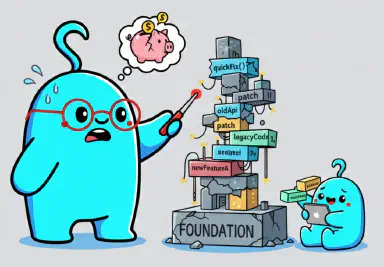
Long-term value delivery. Sustainable software means building systems that remain changeable. Technical debt is not inherently evil—but untracked, unaddressed technical debt compounds into systems that no one dares to modify.
Key Practices
Software craftsmanship is not abstract. It shows up in specific, daily practices.
| Practice | What It Means | Why It Matters |
|---|---|---|
| Test-Driven Development (TDD) | Write tests before writing code | Forces small, testable design; acts as living documentation |
| Refactoring | Improve code structure without changing behavior | Prevents entropy; keeps the codebase changeable over time |
| Pair Programming | Two developers, one keyboard | Real-time code review, faster knowledge transfer |
| Continuous Integration (CI) | Merge and test frequently | Catches integration errors early, reduces branch divergence |
| Clean Architecture | Separate concerns; keep business logic independent of infrastructure | Enables testability and long-term maintainability |
| Technical Debt Tracking | Maintain an explicit backlog for quality debt | Makes debt visible and prioritizable rather than invisible and compounding |
Many of these practices originate directly from Extreme Programming. In teams that practice XP consistently, these habits are non-negotiable—and the result is codebases that teams can sustain and extend for years, not just months.
For practical day-to-day guidance, see How to Write Clean Code. To see how these practices adapt in the age of AI-assisted development, see The Socio-Technical Architecture of Extreme Programming.
Software Architecture as a Craft
Software architecture is where craftsmanship scales from individual code to system design. A software architect with a craftsmanship mindset thinks in terms of:
- Evolvability: Can this system absorb change without a complete rewrite?
- Observability: Do we know what the system is doing in production?
- Resilience: How does the system behave under failure?
- Fitness for purpose: Does the architecture serve the actual business need—not a speculative future one?
Architecture decisions have long half-lives. A poor choice made in year one typically becomes the technical debt of years three through ten. Treating structural decisions as disciplined, reversible where possible, and clearly documented in architecture decision records (ADRs) has an outsized impact on team velocity and system health over time.
The craftsman’s instinct—leave the code better than you found it—applies equally to system architecture: every architectural touch point is an opportunity to reduce complexity, clarify intent, and improve the system’s capacity to evolve.
Software Craftsmanship in the Age of AI-Assisted Development
AI-assisted development tools—GitHub Copilot, Amazon Q Developer, Cursor, and similar systems—have fundamentally changed the economics of code generation. Junior-level boilerplate that once took hours can now be produced in minutes.
This shift raises a critical question: does AI-assisted development make software craftsmanship obsolete?
The answer is the opposite. AI amplifies the value of craftsmanship judgment.
Here is why:
AI generates plausible code, not necessarily correct code. A developer without craftsmanship instincts will accept AI output that looks right but contains subtle bugs, security vulnerabilities, or architectural drift. The ability to recognize well-crafted code is the prerequisite for evaluating AI suggestions.
AI cannot reason about your system’s specific context. Well-factored codebases with clean domain boundaries give AI tools the context they need to generate useful suggestions. Tangled, high-coupling codebases produce tangled AI output.
The bottleneck shifts from writing to reviewing. When code generation is cheap, the scarce skill becomes critical evaluation. Knowing what good code looks like—the core of craftsmanship—becomes the primary differentiator.
Technical debt accumulates faster with undisciplined AI usage. Teams adopting AI code generation tools without craftsmanship discipline are reporting codebases that grew 3–5× in size within 12–18 months, with corresponding increases in complexity and maintenance costs.
Software craftsmanship in the AI era means treating AI as a capable but junior pair programmer: useful, fast, and in need of thoughtful review—not a replacement for professional judgment.
Building a Software Craftsmanship Culture
Individual craftsmen exist on almost every team. A craftsmanship culture is harder to establish—it requires organizational commitment, not just personal discipline.
Key ingredients:
- Psychological safety for quality conversations: Teams must be able to say “this code isn’t ready” without political risk. Without safety, quality concerns go unspoken until they accumulate into crises.
- Explicit quality standards: Shared definitions of done, code review checklists, and architecture decision records create a common language for quality.
- Time for deliberate practice: Reserving 10–20% of sprint capacity for refactoring, tooling improvements, and learning prevents quality debt from compounding indefinitely.
- Mentorship structure: Senior craftsmen actively developing the next generation through pairing, structured feedback, and communities of practice.
- Data-driven technical health: Regular measurement of test coverage, cyclomatic complexity, coupling metrics, and deployment frequency makes quality visible to non-technical stakeholders.
A 2023 McKinsey analysis of software delivery performance found that teams with explicit technical quality practices and debt management processes delivered features 40% faster over a 12-month horizon than teams that deprioritized quality in favor of short-term speed. Craftsmanship is not slow—undisciplined speed is slow.
For a step-by-step guide to building this culture deliberately in your engineering team, see How to Build a Software Craftsmanship Culture.
Real-World Impact: Metso
Theory earns its value when it produces measurable results.
Bytecraft partnered with Metso—a global industrial technology company—to address a challenge common to many large engineering organizations. More than 80% of surveyed developers identified managing complexity as a significant barrier to productivity. Development effort was being consumed by technical debt rather than feature delivery.
The engagement applied software craftsmanship principles at organizational scale:
- Established shared coding standards and a culture of team ownership
- Introduced testing automation frameworks and refactored architecture for cost savings and performance gains
- Created a transparent technical debt backlog with explicit, data-driven prioritization
- Enhanced developer onboarding to embed quality practices from the first day
The outcome was concrete: simplified code structure, faster debugging cycles, and increased development velocity. As one senior Metso developer put it: “Development was made simpler and faster with the simplified code structure supported by commonly agreed practices.”
This is software craftsmanship at organizational scale—not as a personal philosophy but as a structural change that compounded into lasting competitive advantage.
Read the full Metso case study →
Frequently Asked Questions
What is software craftsmanship?
Software craftsmanship is a professional philosophy that treats software development as a skilled trade requiring mastery, ethics, and continuous improvement. It was formalized by the Manifesto for Software Craftsmanship in 2009 and emphasizes well-crafted software, steadily adding value, a community of professionals, and productive partnerships between developers and clients.
What is the difference between software craftsmanship and Agile?
Agile is a project management philosophy focused on iterative delivery and adapting to change. Software craftsmanship is a technical philosophy focused on code quality, professional discipline, and sustainable engineering practice. They are complementary: craftsmanship provides the technical foundation that makes Agile practices work at speed without accumulating crippling technical debt.
How does Extreme Programming relate to software craftsmanship?
Extreme Programming (XP), developed by Kent Beck and first published in Extreme Programming Explained (1999), is a software development methodology that codifies core craftsmanship practices: test-driven development, pair programming, continuous integration, and frequent refactoring. Software craftsmanship can be understood as the professional identity and ethical framework within which XP practices make lasting sense.
Is software craftsmanship still relevant with AI-assisted development?
Yes—more so than before. AI code generation tools make writing code cheap; they do not make evaluating, refactoring, or maintaining code easier. The ability to recognize high-quality code, reason about architectural trade-offs, and make sound engineering decisions—all core to craftsmanship—is exactly what turns AI-generated output into production-worthy software.
How long does it take to build a craftsmanship culture?
Cultural change in software teams typically takes 12–24 months to become self-sustaining. The key phases are: establishing psychological safety (months 1–3), agreeing on shared quality standards (months 2–4), embedding practices through mentorship and pairing (months 3–12), and seeing measurable improvement in delivery metrics (months 6–18).
Conclusion
Software craftsmanship is not nostalgia for handcrafted code in a world of AI-assisted development. It is the professional discipline that makes software systems sustainable, teams effective, and organizations capable of delivering value year after year—not just in the next sprint.
The core insight is durable: code that is easy to change is more valuable than code that merely works today. Getting there requires technical excellence, shared standards, continuous learning, and a culture that treats quality as a feature—not a constraint.
Whether you are a developer, a team lead, or a CTO making architecture decisions, craftsmanship thinking pays compound interest over time. It is the foundation on which fast, sustainable teams are built.
Want to see what software craftsmanship looks like at organizational scale? Read how Bytecraft partnered with Metso to transform a complexity-bound engineering organization into one that ships faster, with less friction.
Curious about what the crafter mindset looks like from the inside? Read what it means to be a crafter at Bytecraft.
Ready to build craftsmanship practices in your own organization? See how Bytecraft works with engineering teams.